Development and manufacturing

Different products, one engineering discipline.

Packaging machinery, laser diodes, amino acids, insulation laminate, titanium reactors and motor cores are made in different buildings by different specialists — but they are developed the same way, measured against the same standards and released on the same documentation. That is what holds the group together.

Feasibility and an indicative delivered cost within a working week. Mutual NDA before any file is opened.

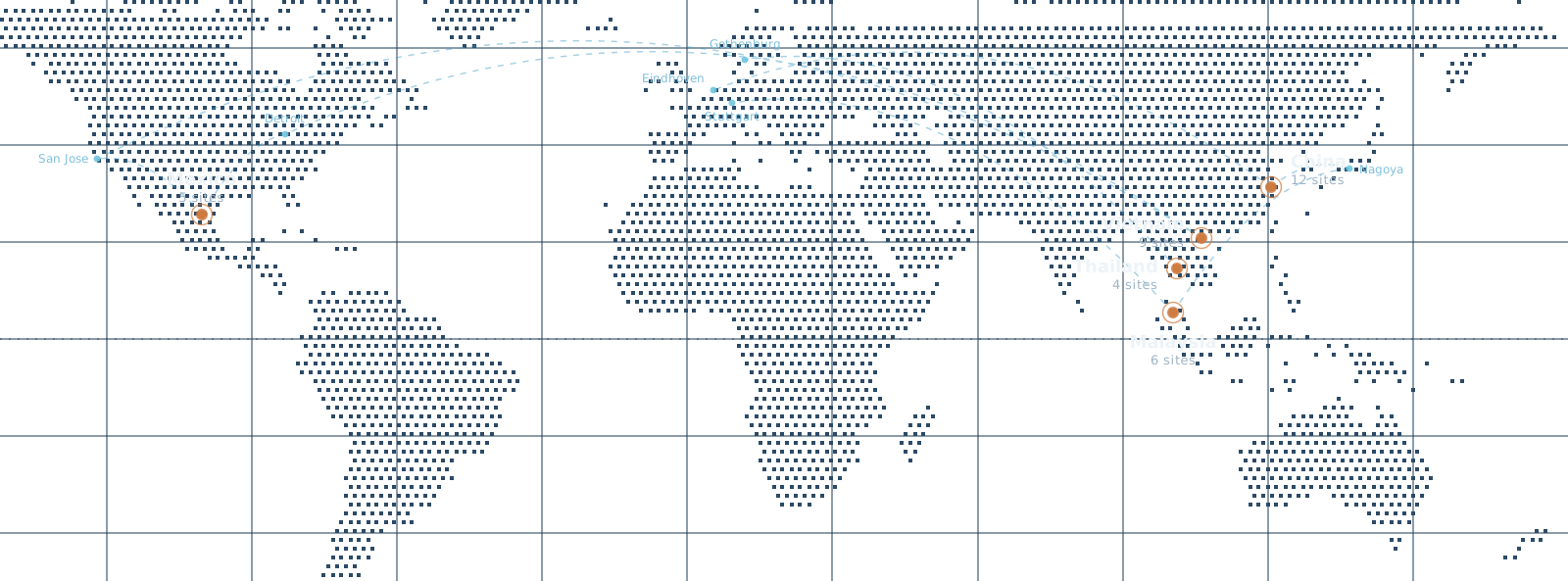
World map showing United Works Group plants in Vietnam, Malaysia, Thailand, China and Mexico, with delivery lanes to customer engineering centres in North America, Europe and Japan.
Our factories Customer engineering centres Regular shipping lane
Industries served
16
Countries producing
5
Tightest tolerance held
±2 µm
Lysine capacity
180 kt/y
On-time delivery, 2025
98.4%
Customer PPM, 2025
143

United Works Group at a glance

What we are
A manufacturer. Product development, tooling and production happen in our own factories, and we sell directly to the companies that use what we make.
What we make
Sixteen industries, from packaging and agricultural machinery to optoelectronics, amino acids, insulation materials, titanium, motors, lighting and vehicle parts.
Where we make it
Factories in Vietnam, Malaysia, Thailand, China and Mexico, each dedicated to one kind of work rather than shared between unrelated processes.
How we are certified
ISO 9001 at every factory, with IATF 16949, ISO 13485, AS9100D, ISO 14001, ISO 45001, ISO 22000, FAMI-QS and UL recognition held by named plants.

Where we are strongest

Where the engineering runs deepest.

These carry the most engineering content and the largest development teams. The rest are set out on the industries page, each with its product scope and the figures its line holds.

Industrial machinery

Packaging machinery from a single filler to a complete line: form-fill-seal baggers, volumetric and auger fillers, labellers, shrink wrappers, palletizers and strapping. Machines are dosed against the customer’s own product on a test rig before a specification is written.

Filling accuracy
±0.5% of target
Bagging rate
to 120 bags/min
Seal temperature
±1.5 °C at the jaw
Safety rating
EN ISO 13849-1 PL d
Industrial machinery

Optoelectronics

Laser diodes, photodetectors, fibre preforms and cable, CMOS image sensors, thermal imaging modules, lenses and prisms, and LED epitaxial wafers. Epitaxy, polishing, coating and hermetic assembly happen in the same building, so a die fault and a coating fault can actually be told apart.

Surface figure
λ/20 at 632.8 nm
Surface quality
10/5 scratch–dig
Aperture range
Ø3–300 mm
Assembly class
ISO 7 cleanroom
Optoelectronics

Electrical insulation materials

Polyimide and PET film, DMD and NMN laminate, mica tape, insulating varnish and impregnating resin, fibreglass sleeving, epoxy and phenolic laminate, and heat-shrink tubing. We would rather supply the slot liner cut and formed than the roll it came from.

Thermal class
B, F and H
Breakdown voltage
≥ 12 kV/mm
Slit width
10–1000 mm
Approvals
UL, IEC 60626
Electrical insulation

Bio-based products and amino acids

Feed-grade lysine, threonine and valine, monosodium glutamate, lactic acid and lactates, PLA resin and compostable compounds, and corn starch derivatives. The corn is milled here, so the glucose feeding the fermenters is a known quantity rather than an inherited one.

L-lysine HCl assay
≥ 98.5%
Fermenter volume
500 m³
Loss on drying
≤ 1.0%
Certification
FAMI-QS, ISO 22000
Bio-based products

How we work

The people quoting your job are the people running it.

The process engineer who will set the machine reads the drawing before the price leaves the building. That is why a quotation carries a tolerance we can hold rather than one we hope a supplier will accept, and why an honest “not on our equipment” arrives early rather than at first article.

About the group

Process data, not sales figures

Capability studies come off the machine that will run your part, on the material you specified. If the study says we cannot hold the print, we say so before the tool is cut.

A second line already qualified

Most part numbers are proven on lines in two countries. When a tariff line moves or a port stops, the drawing package and an approved first article are already in place.

Records that survive an audit

Melt and batch numbers, measured values rather than pass marks, and substance declarations issued from our own laboratory results.

Our escapes, our cost

Sorting, rework, replacement and the premium freight needed to keep your line running are funded by us when the fault started here. That sits in the supply agreement.

Process capability

What our machines actually hold in volume.

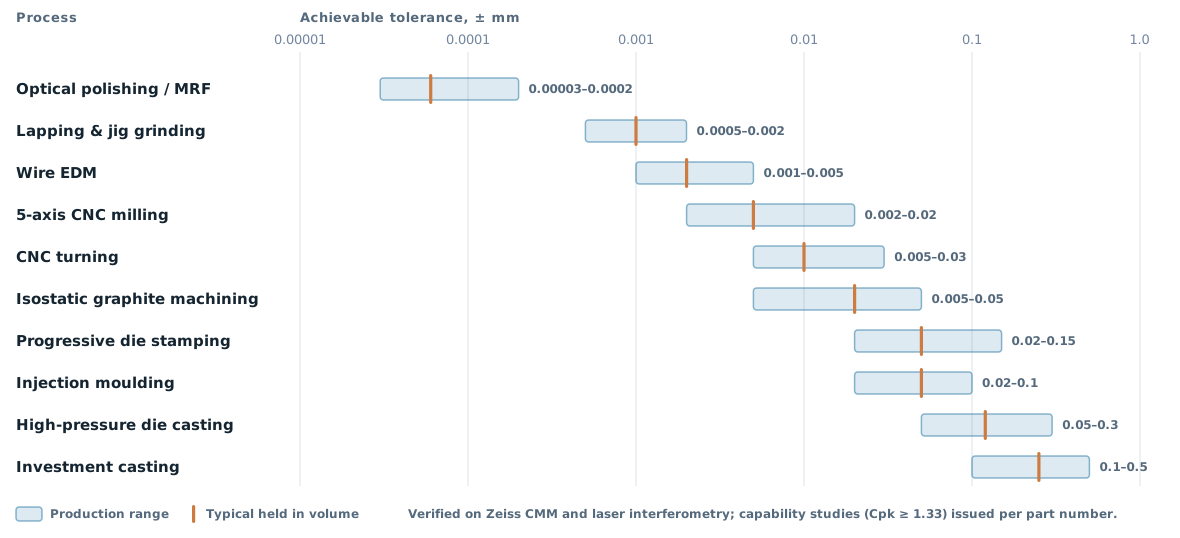
A quoted tolerance means little without the process behind it. The band below is what our lines sustain across a production run, not a best-case first article; the marker is the figure we will write into a contract. Anything tighter is a conversation about fixturing, thermal control and inspection cost, and we would rather have it before the tool is cut.

Chart of achievable dimensional tolerance by manufacturing process, from optical polishing at tens of nanometres to investment casting at half a millimetre.

From drawing to serial production

Every phase closes on a document you can hold us to.

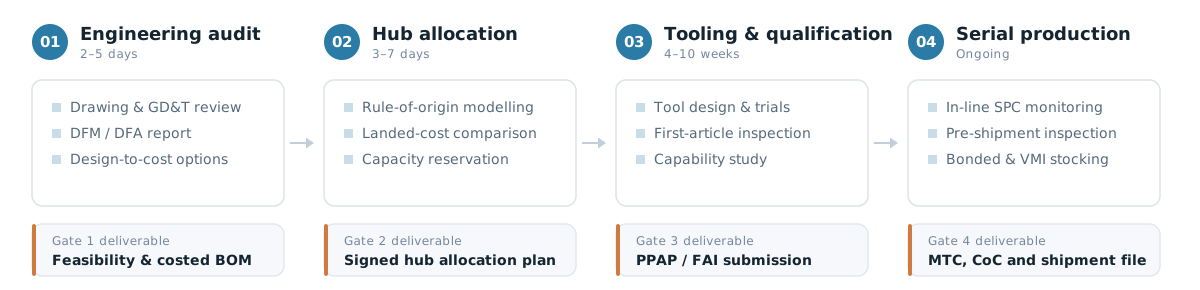
Execution model: engineering audit, plant allocation, tooling and qualification, then serial production, each closing with a named deliverable.

Before you send anything

The questions buyers ask first.

If yours is not here, ask it directly — a process engineer answers, not a mailbox.

Ask an engineer
What is your minimum order?

It follows the process, not a group policy. Machined and optical parts start where the setup and inspection cost can be spread, usually a few dozen to a couple of hundred pieces. Stamped and moulded parts need annual volume that justifies a tool. Insulation materials go by slit width and roll length, and amino acids by full container or jumbo-bag pallet. Tell us the annual quantity and we will say plainly whether we are the right works for it.

Who owns the tooling?

You do, once it is paid for. Tools carry your asset number, are photographed at handover and are listed in the contract by plant. If you move the programme the tool moves with it, along with the trial records and the die maintenance log.

How do you protect our drawings?

A mutual NDA is signed before any file is opened. Drawings sit in an access-logged repository and reach a shop floor as the specific views that operation needs, never as the whole package. Files are purged from the plant network ninety days after a programme closes.

Can we walk the factory ourselves?

Yes, and we prefer it. Any factory making your parts is open to you or to an agency you appoint, with ten working days’ notice, including unannounced re-audits once a programme is running. The audit page sets out scope and what we prepare in advance.

What happens when a shipment fails inspection at our dock?

Containment within a day, an interim 8D within three working days, and a closed 8D with verified corrective action within twenty. Sorting, rework, replacement and the premium freight to keep your line running are at our cost where the escape started with us. That commitment is in the supply agreement, not in a brochure.

Send us one part number and see how we work.

A drawing or a specification, an annual quantity and where you need it delivered is enough. You get a feasibility note, the line we would run it on, the tooling route and an indicative delivered cost — and an honest answer if the job belongs somewhere else.

Start a technical review

No account, no call scheduling. One form, one engineer.